



AI tools for furniture retailers are no longer just an option for big retailers or a feature for the future. Today they’ve become the real difference between a store that grows and a store that struggles to survive in a market that shows no mercy to those who fall behind. The furniture retailer in 2026 faces a difficult equation, on one hand, competition keeps rising, new stores open every day, and online platforms display thousands of products with a single click. On the other hand, the buyer has become more discerning and harder to convince, he researches before he visits, compares before he asks, and expects an experience worthy of a decision he’ll live with for years.
In this article, we review the best AI tools for furniture retailers, and how to choose the tool that actually doubles your sales and sets you apart from others in the market.
Why Traditional Methods Are No Longer Enough To Grow A Furniture Store?

The furniture retailer who still relies today on the same tools that used to work five years ago finds himself in a race he’s slowly losing without knowing exactly why.
Sales don’t collapse suddenly, they erode gradually, and every season looks harder than the one before, and every ad campaign delivers weaker results than the one before it.
Beautiful photos bring in visitors, and that’s true, but the visitor who lands on your product page and sees a photo of a sofa against a white background, no matter how professional that photo is, still faces the same question he had before he arrived: how will this sofa look in my room?
And because the buyer doesn’t find an answer, he closes the page and moves on to the next store.
And you, as the retailer, have already paid the cost of acquiring him without getting anything in return.
Repeated discounts also carry a deeper cost than they appear to. Although they drive sales in the short term, they teach your customer to wait for the deal instead of buying at full price.
Gradually, you find yourself in a discount spiral, competing on margin instead of loyalty.
And the customer who buys from you because you’re the cheapest at this moment will go to your competitor when he’s the cheapest the next moment.
That’s why today’s smart buyer isn’t looking for the cheapest option, he’s looking for certainty that what he buys will look the way he imagines it, will fit his space, and will match what he already owns.
And the retailer who gives him this certainty doesn’t need discounts to convince him.
What Do You Actually Need From AI Tools For Furniture Retailers?
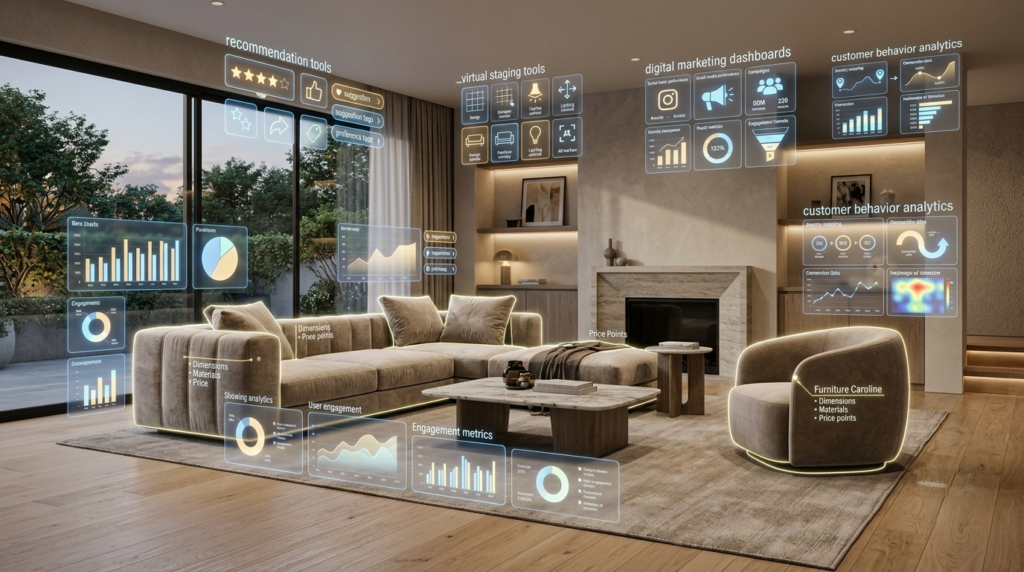
When a furniture retailer looks for an AI tool, the first question he should ask isn’t “what are the latest tools?” but “what problem do I actually need to solve?”
A tool that solves the wrong problem just adds cost, not value. Among the most common problems furniture retailers face, and need the right tools to solve, are:
The Visualization Problem
This is the first and most impactful problem, since 78% of customers abandon their furniture shopping cart, not because they dislike the products or because the prices are too high, but because they can’t picture the product in their actual space.
That’s why AI tools for furniture retailers that solve this problem are, at the same time, solving 78% of the losses in the furniture trade.
Low Average Order Value
The customer who buys a single piece could have bought an entire room if he’d been shown smart recommendations that show him how the pieces come together in a complete design.
A tool that gives you this naturally raises the value of every order, without any direct sales pressure.
Lack Of An Experience That Builds Loyalty
A customer who goes through an exceptional shopping experience comes back, because a good experience is remembered and talked about.
And a tool that makes the shopping journey enjoyable and convincing builds a base of loyal customers, not a base of scattered one-off deals.
How Do You Choose The Right AI Tool For Your Furniture Store?

Today the market includes a growing number of AI tools for furniture retailers that promise to improve sales.
Each one seems convincing in the demo, but what sets apart the tool that deserves your investment comes down to four real criteria:
Accuracy Of Product Visualization In A Real Environment
A tool that places your products in a virtual environment unrelated to the customer’s actual space doesn’t solve the visualization problem, it just dresses it up.
The real tool is the one that places your products in a room that resembles the customer’s own room, with its true dimensions, colors, and actual lighting.
Ease Of Integration With Different Sales Channels
A tool that only works on a separate external platform, disconnected from your website and your showroom, doesn’t give you a complete solution.
But a tool that works on your website, in your showroom, and across digital platforms all at once ensures your products reach the customer wherever he is, thereby boosting online furniture sales.
Smart Recommendations That Naturally Raise The Cart Value
A tool that suggests random products unrelated to the customer’s choice doesn’t raise the cart value, it just confuses the customer.
The best AI tools for furniture retailers are the ones that suggest pieces that match the customer’s choice in style, dimensions, and colors, at the right moment and in a natural way.
Performance Reports That Show You What Works And What Doesn’t
A tool that doesn’t give you clear data on each product’s impact on the purchase decision leaves you working in the dark.
Having reports that show you impressions, conversions, and cart impact turns development decisions from guesswork into strategy.
How Do AI Tools Increase Furniture Sales?
The relationship between AI tools and increased furniture sales isn’t a technical relationship, it’s a psychological and behavioral relationship that works through three complementary mechanisms:
Placing The Product In A Real Context That Convinces, Not Just Pleases
Liking something isn’t enough to complete a purchase, certainty is. When the customer sees your product inside a room that resembles his own, with its true dimensions and matching colors, liking turns into certainty.
And the customer’s certainty is the shortest path to the buy button, and this is exactly what AI furnishing tools give you.
Smart Cross-Selling
A customer who sees a sofa on its own buys a sofa, while a customer who sees a complete room buys a room. This difference in visual context is what naturally raises the average order value.
The most successful AI tools for furniture retailers are the ones that excel at delivering the smart recommendation at the exact moment the customer is at his highest level of attention and enthusiasm, thereby enhancing the furniture shopping experience.
Reducing Cart Abandonment By Addressing Its Root Cause
Discounts and email reminders treat the symptoms of cart abandonment, but the smart tool treats its cause.
When the customer sees your product in his actual space and artificial intelligence answers every question that would have stopped his decision, the reasons for abandonment disappear automatically.
What Are The Best AI Tools For Furniture Retailers In The Gulf Market?
Zory is considered one of the best AI interior design tools, built from day one with a deep understanding of the furniture retailer’s problem in the Gulf market.
What it offers isn’t technical features, but solutions to real problems every retailer lives with daily. It offers retailers this through three complementary channels:
Products Appearing In Smart Designs In Front Of Thousands Of Users
On the Zory online platform, your products appear inside AI-generated room designs in front of more than 4,000 active users monthly, meaning customers who are actually looking for what you sell.
This organic exposure doesn’t cost you any additional ad budget, alongside monthly reports that show you impressions, conversions, and each product’s impact on the purchase decision.
An API For Your Website So The Customer Designs And Buys Without Leaving The Page
One of the things that most sets Zory apart, and makes it one of the strongest AI tools for furniture retailers, is that it offers a tool that integrates the design experience directly into your product pages.
As a result, the customer is able to upload the room’s layout and dimensions, then see your product in his actual space, and buy with full confidence without leaving your website.
This integration happens quickly and without needing any technical expertise, with a direct impact on the conversion rate.
A Showroom Tool To Close Deals In The Same Session
This works as an interactive sales tool in your showroom with a screen or tablet. Your team can design the customer’s room with your products right in front of him, turning hesitation into a decision, and raising the invoice value because the customer sees the whole room, not a single piece.
Behind all of this is a live catalog of more than 50,000 products from trusted merchants in the Gulf market.
All of them are directly linked to every design the customer sees, so that the moment of admiration never stays hanging, it instantly turns into a chance to buy.
Remarkable Results From Using AI Tools For Furniture Retailers

The numbers achieved with the Zory platform in the Gulf furniture market, after using its smart tools, were remarkable:
- A 20-fold difference in conversion rate, and this difference doesn’t come from better products but from an experience that gives the customer what he was missing to make his decision.
- A 40% increase in average order value, thanks to smart recommendations for other products, delivered naturally without any direct sales pressure.
- A noticeable drop in the furniture cart abandonment rate, because artificial intelligence answers the question that used to stop the purchase decision. The result is more sales from the same number of visitors.
How Do You Get Started With AI Tools For Furniture Retailers In Your Store With The Least Complexity Possible?
Many retailers put off this decision because they imagine that adopting artificial intelligence means a huge technical project that eats up time and resources.
But with the Zory platform, the reality is completely different, since:
- Start With The Channel That Best Fits Your Current Need
You don’t need every channel at once, you can start with whichever one solves your most urgent problem, where:
- If your main problem is in your online store, start with the website API tool.
- If it’s in your showroom, start with the showroom tool.
- And if you want organic exposure to new customers, start with the Zory online platform.
- Fast Integration Doesn’t Require Technical Expertise
The Zory team handles everything, from connecting the catalog to setting up the interface. So as a furniture retailer, you don’t need a developer or a technical team, you just need a decision and your product catalog, and that’s exactly what Zory makes easy for you.
Conclusion
AI tools for furniture retailers aren’t a technical luxury, they’re the practical answer to one question that troubles every retailer daily: why do my customers browse but not buy?
And the answer, as we’ve seen, isn’t in discounts or prettier photos, it’s in an experience that gives the customer the visual certainty that turns his hesitation into a decision.
Zory gives you this experience in the Gulf market, with three complementary channels, a live catalog of more than 50,000 real products, and performance reports that show you exactly where you’re losing sales and how to win them back.
Register with Zory today, add your products to its massive catalog, and turn your store from a store that’s browsed into a store that’s bought from, before your competitor does.