



An AI agent for furniture retailers helps stores deal with one of the biggest challenges in e-commerce: turning a customer’s interest in products into an actual purchase decision. When someone is searching for a sofa that suits the living room, they may need to know its dimensions, compare its price with others, make sure it matches the home’s decor, and perhaps see how it looks inside the room before buying it. With so many needs, traditional customer service methods are not always enough to provide the help shoppers expect. This is where the smart agent comes in, understanding customers’ requests and helping them at the different stages of shopping.
In this article, we explain what an AI agent for furniture retailers is, the most important solutions it offers, and how to benefit from them.
What Is an AI Agent for Furniture Retailers?

It is a digital assistant that relies on artificial intelligence technologies to understand customers’ needs, interact with them, and help them at the different stages of furniture shopping.
This starts from searching for a piece of furniture with certain specifications, through comparing products and choosing the right design, and up to managing the shopping cart and completing the purchase.
Unlike traditional chatbots, which are often limited to answering frequently asked questions with predefined responses, the smart agent can:
- Understand the context of the conversation.
- Handle follow-up questions.
- Use product information and store policies to provide answers and recommendations related to the customer’s request.
The importance of this type of solution appears in the furniture trade in particular, because the purchase decision does not depend on price or appearance alone, but is linked to multiple factors, including:
- Sizes and spaces.
- Design and coordination.
- Budget.
- Specifications and quality.
- Availability and purchase.
Thus, an AI agent for furniture retailers does not work merely as a channel for answering inquiries.
Rather, it plays the role of a shopping assistant and a digital sales consultant that links the customer’s needs with the products the store offers.
How Does the Smart Agent Help Furniture Stores Serve Customers and Increase Sales?
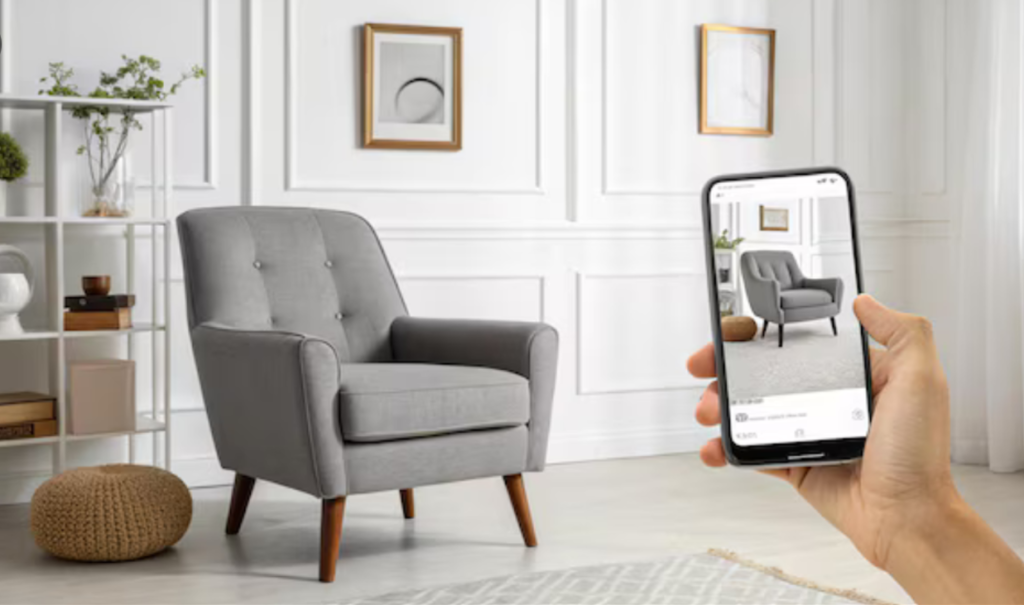
Furniture store owners face a challenge in helping every customer choose the right product amid the variety of models, sizes, materials, and prices.
A customer may enter the online store looking for a complete bedroom, but not know which pieces they need, how to coordinate them, or what suits the space available to them.
If the customer does not find clear answers and enough help, they may postpone the purchase decision or turn to another store.
Here, an AI agent for furniture retailers helps improve the shopping journey through a set of interconnected solutions, most notably:
- Providing personalized help for each customer after understanding the shopper’s needs, budget, and preferences.
- Making it easier to find products, whether through searching using the customer’s natural description or a picture of the piece of furniture they want.
- Supporting purchase decisions by clarifying product specifications and comparing the available options, which helps the customer understand the differences and choose what suits their needs.
- Linking design to shopping by helping the customer visualize furniture inside the space they want to furnish, and choose products that suit the design.
- Offering complementary suggestions by recommending furniture pieces and accessories that match the products the customer has chosen, which helps them complete the furnishing of the room and gives the store additional cross-selling opportunities.
- Supporting the sales team, as the AI agent for furniture retailers handles the inquiries and tasks it is able to carry out, with the possibility of transferring the conversation to a specialized employee when the customer’s case requires human intervention.
What Solutions Does the Smart Agent Offer to Furniture Stores?

Zory’s smart agent offers a set of solutions that cover different stages of the customer journey.
Its task is not limited to answering inquiries, but extends to helping the customer discover and compare products, plan spaces, choose suitable furniture, and manage purchases.
In return, store owners get tools that help them understand customer behavior, support sales teams, and make better use of store data.
Below are the most prominent solutions of Zory’s AI agent for furniture retailers:
Smart Conversation and Interaction with Customers
The smart agent allows customers to interact with the store using natural language, whether through writing or voice, with support for multilingual conversations.
It can answer questions based on company information, products, and sales policies, while understanding the context of the dialogue and retaining its details to continue the discussion without asking the customer to repeat information.
Smart Vision and Understanding Images and Spaces
The customer does not always need to know the name of the product or describe it accurately in order to find what they are looking for; they may have a picture of a piece of furniture they liked or a picture of a room they want to renovate.
Here, Zory’s AI agent for furniture retailers uses smart vision technologies to analyze images and recognize the furniture pieces and elements in them. These solutions can help with:
- Recognizing a piece of furniture within an image, even when there are several products in the scene.
- Searching for products similar to the image the customer shares.
- Analyzing room plans and recognizing spaces.
- Identifying the furniture and elements present inside the space in order to understand the furnishing needs.
Thus, visual search becomes an additional way to discover furniture and products, especially when it is difficult to express their appearance in words.
Smart Search and Product Discovery
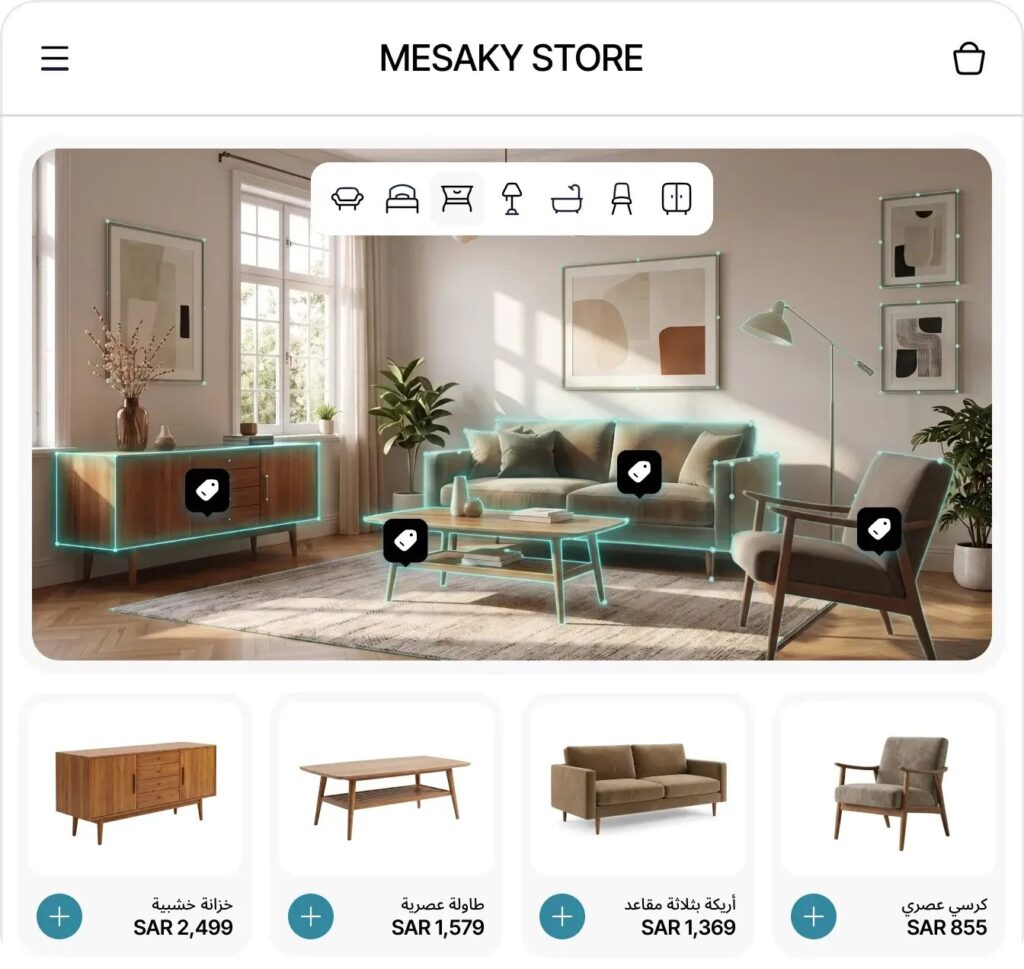
Instead of relying on typing the product name or browsing the store’s categories one after another, the customer can describe what they are looking for in simple language, such as: “I want a wooden dining table for four people at a reasonable price.”
The agent analyzes the request to find products that match the stated specifications.
The customer can also modify their request during the conversation, or ask for cheaper alternatives, similar products, or options that better suit the space available to them.
Product Information and Smart Comparison
A customer may find several pieces of furniture that look similar, but needs to know the differences between them before making a purchase decision.
Therefore, the AI agent for furniture retailers helps present product information, such as:
- Dimensions.
- Materials.
- Colors.
- Available options.
- Prices, discounts, and ratings.
Its role does not stop at displaying specifications; it can compare products according to multiple criteria, such as price, quality, materials, use, ratings, warranty, return policy, and the suitability of the product for the space and budget.
Interior Design and Space Planning
One of the most prominent challenges facing furniture buyers is the difficulty of imagining how the pieces will look once placed inside the home, or how well they will match the existing furniture.
Here, the agent links shopping with interior design, to help the customer plan rooms and choose products suitable for the space, the budget, and the preferred style.
Among the available solutions of the AI agent for furniture retailers are:
- Planning rooms and furnishing empty spaces.
- Creating interior design concepts according to the customer’s needs.
- Using real products from the store’s catalog inside the design.
- Trying out replacing one piece of furniture with another or adding a specific product to the design.
- Coordinating colors, materials, and pieces with the existing furniture.
- Preparing inspiration boards and shopping lists linked to the design.
Smart Shopping and Shopping Cart Management
After choosing the products, the agent helps the customer manage their purchases and review their selections before completing the order.
It can add products to the cart, modify quantities or options, and remove items or replace them with other alternatives. It also supports budget tracking by:
- Calculating the total value of the selected products.
- Showing the remaining amount of the budget.
- Alerting the customer when they exceed the limit they set.
- Suggesting alternatives that fit the available amount.
- Displaying discounts and estimated delivery costs and taxes when data is available.
- Verifying the validity of coupons and offers.
- Checking product availability before moving on to payment.
Increasing Sales Value and Cross-Selling
The sales opportunity does not end once the customer has chosen the main product; they may need other pieces that complement its use or match it.
Therefore, the AI agent for furniture retailers can suggest complementary products based on the customer’s choices, the contents of the shopping cart, or the design they are working on.
These solutions help furniture stores take advantage of cross-selling opportunities and increase the order value, while offering suggestions that are actually related to what the shopper is looking for.
Inventory Management and Product Availability
A customer may choose a particular product, then discover that it is unavailable or that the color they prefer is not in stock.
To reduce this problem, the agent helps the store provide information about product availability, including quantities, branches, colors, and different options, according to the data connected to the system.
If the product is unavailable, it can suggest suitable alternatives, point out low-stock products, or register the customer’s interest in a product so that they are notified when it is back in stock, according to the approved integration capabilities.
Thus, smart inventory management does not stop at displaying the product’s status, but extends to helping the customer continue shopping instead of stopping when their first choice is unavailable.
Customer Memory and Understanding Preferences
Customer memory helps the AI agent for furniture retailers provide an experience more closely tied to each shopper’s interests, by drawing on the information they share during conversations and their interactions with the store, according to the available data and the approved privacy settings.
Purchase Intent Analysis and Conversion Improvement
Not all customer inquiries are alike; some customers are looking for preliminary information, while others are ready to buy but hesitant because of the price, the sizes, or the unclear differences between products.
The agent helps analyze conversations and interactions to understand the customer’s intent and the stage they have reached in the purchase decision.
It then determines the most suitable next step, such as suggesting an alternative product, clarifying missing information, providing AI product recommendations related to the customer’s needs, or transferring them to a sales employee when they need specialized help.
Smart Marketing and Customer Re-Engagement
This is one of the best solutions of the AI agent for furniture retailers from Zory.
It aims to re-establish contact with customers based on their interests and previous interactions with the store, through:
- Reminding customers of products left in the shopping cart.
- Following up on products the customer saved but did not buy.
- Sending notifications when a product is back in stock or its price drops.
- Providing recommendations and offers that suit each customer’s interests.
- Re-engaging customers based on their previous conversations or the designs they worked on.
- Supporting communication through channels such as WhatsApp and email.
Transferring Conversations to Sales Staff
Despite the agent’s ability to handle a wide range of inquiries and tasks, there may be cases that require the intervention of a sales employee, such as a request for specialized consultation, an objection that needs direct discussion, or the customer’s desire to discuss additional details.
In these cases, the AI agent for furniture retailers can recognize the need for human help and transfer the conversation to the specialized employee, passing on the context and the information collected during the interaction.
This reduces the need to explain the request again from the beginning, and helps the sales employee continue the conversation with a clear understanding of the customer’s needs.
After-Sales Services and Customer Service
With an AI agent for furniture retailers, the customer’s help does not end when the purchase is completed, but continues through the stages of receiving and using the product. The most prominent available services include:
- Inquiring about the order status, tracking the shipment, and the expected delivery date.
- Requesting a change to the delivery date or address.
- Inquiring about modifying or canceling the order.
- Submitting return, exchange, and refund requests.
- Reporting damaged products or missing pieces.
- Inquiring about the warranty and spare parts.
- Booking installation services or requesting help with assembly.
- Getting product care instructions.
Business Analytics and Sales Intelligence
Furniture store owners need to understand what customers are actually looking for, which products attract their interest, and which factors affect purchase decisions.
Therefore, the AI agent for furniture retailers provides solutions for analyzing interaction, conversation, and sales data, and turning them into indicators that help management evaluate the store’s performance. The analytics can also include:
- The most viewed, recommended, added-to-cart, or purchased products.
- Products that customers reject or back out of buying.
- Shopping cart abandonment and conversion rates.
- The most frequent questions and objections.
- The performance of recommendations and cross-selling.
- Customer preferences and behavior patterns.
- The performance of sales made with the agent’s help.
This information helps the store identify market needs, determine the obstacles facing customers, and make better decisions about products, recommendations, and sales strategies.
Specialized Agents by Task
Not all stores need an agent that performs the same tasks in the same way; one store’s main focus may be interior design, while another store needs sales support or customer service.
Therefore, Zory’s smart agent includes the ability to offer specialized agents according to the nature of the required task. Examples of these agents include:
- AI interior design agent: helps customers plan rooms, choose furniture, and coordinate products.
- Sales agent: supports discovering customers’ needs, providing recommendations, and helping them make the purchase decision.
- Shopping agent: helps with searching for products, comparing them, and managing the cart.
- Customer service agent: handles inquiries and requests related to serving shoppers.
- Home planning agent: helps organize and plan the furnishing needs of spaces.
Customizing the Smart Agent for Businesses
Each store’s identity differs from the next, whether in communication style, products, or sales rules and offers.
For this reason, Zory’s AI agent for furniture retailers offers solutions for customizing its experience to suit the nature and brand identity of the company. Customization includes the ability to:
- Choose the agent’s name, personality, and communication tone.
- Provide it with company information, products, and policies.
- Connect it to the store’s own product catalog.
- Define sales rules and promotional offers.
- Adjust the recommendation logic and the way products are suggested.
- Remove the phrase “Powered by ZORY” according to the available customization option.
Thus, companies can offer an AI agent for furniture retailers that speaks in a style consistent with their brand and relies on their own product information and rules, instead of providing a generic experience that does not reflect the store’s identity.
How Does Zory’s Smart Agent Help Improve the Shopping Experience in Furniture Stores?

Zory’s smart agent makes the shopping journey more connected, by helping the customer move from the stage of searching and exploring to choosing products and preparing their purchases. This appears in several aspects, including:
- Making product discovery easier.
- Providing recommendations that suit their needs.
- Clarifying the differences between products.
- Linking shopping with interior design.
- Helping them stay within the budget.
- Completing the room’s needs.
For example, if a customer wants to furnish a small living room, they can share a picture of the room and specify the budget and the style they prefer.
Zory’s AI agent for furniture retailers helps them understand the space, explore suitable pieces of furniture, compare the options, and then choose the products and add them to the shopping list.
How Do Furniture Store Owners Benefit from Zory’s Smart Agent?

The benefits of Zory’s smart agent are not limited to improving the shopper’s experience, but extend to helping furniture store owners manage customer interaction, understand their needs, and take advantage of sales opportunities.
The most prominent ways businesses benefit include:
- Supporting the sales and customer service team.
- Understanding customer preferences.
- Discovering upselling and cross-selling opportunities.
- Reducing obstacles to purchase.
- Making better use of store data.
- Providing an experience consistent with the brand identity.
The importance of this benefit lies in the fact that the agent does not provide support to the customer in isolation from the store’s goals; rather, it links the shopper’s needs with the available products, and helps the work team understand the conversations and interests that may lead to actual sales opportunities.
Conclusion
Zory’s AI agent for furniture retailers combines understanding customer needs, product discovery, interior design, purchase management, and business analytics within a single system directed at the furniture and decor sector.
Store owners can contact the sales team and learn about the solutions of Zory’s smart agent, and choose what suits the nature of their business and their goals in developing the shopping experience and supporting sales.
FAQs
What Is the Difference Between a Smart Agent and a Traditional Chatbot?
A traditional chatbot is often limited to answering frequently asked questions according to specific scenarios, while the smart agent can understand the context of the conversation, analyze the customer’s needs, provide recommendations, and carry out tasks such as searching for products and managing the shopping cart.
How Does the Smart Agent Help Increase Furniture Store Sales?
It helps by making it easier to discover and compare products, providing recommendations that suit customers’ needs and budgets, suggesting complementary products, and addressing the obstacles that may delay the purchase decision.
Can the Smart Agent Suggest Furniture That Suits the Room’s Space?
Yes, it can analyze pictures of rooms and architectural plans, understand the dimensions and needs of the space, and then suggest suitable pieces of furniture and coordinate them within an interior design concept.
Can the Smart Agent Compare Products and Prices?
Yes, it can compare products according to price, dimensions, materials, colors, ratings, and other available specifications, to help the customer choose what best suits their needs and budget.
How Can the Smart Agent Be Customized to Fit the Store’s Identity?
Its name, personality, and communication tone can be customized, and it can be provided with company information, the product catalog, and sales policies and offers, in addition to adjusting the recommendation rules to suit the store’s identity and way of working.