



Using a chatbot for furniture stores may seem like a suitable solution for answering customers’ inquiries and helping them while they shop, especially with the large number of products and the variety of sizes, materials, and designs. But are ready-made answers and predefined responses enough to help the customer choose furniture pieces or coordinate them with their home decor? In many cases, a shopper’s needs go beyond getting a quick answer, and require an understanding of context and recommendations tied to their preferences and budget.
In our article, we will explain the most prominent shortcomings of the traditional chatbot, and the difference between a chatbot and an AI agent. We will also show how Zory’s smart agent can offer customers a more integrated experience.
How Does a Traditional Chatbot Work in Online Stores?

A traditional chatbot relies on a set of predefined responses and scenarios to interact with online store visitors, as it recognizes certain words or questions and then displays the answer linked to them.
When a customer asks about a product’s price, the delivery cost, or the return policy, the chatbot provides the information stored in it, without needing an employee to step in each time.
Among the most prominent tasks that a traditional chatbot for furniture stores can perform are:
- Answering frequently asked questions related to products and store policies.
- Displaying shipping, delivery, and payment method information.
- Directing customers to certain product categories or pages.
- Collecting customer data and contact requests.
- Transferring some inquiries to the customer service team.
These functions help organize communication with customers and provide quick answers to basic information. But the robot’s efficiency remains tied to the scenarios and data it was prepared for.
This may limit its ability to handle more complex requests, especially in furniture stores that require help beyond answering direct questions.
Why Is Using a Chatbot for Furniture Stores Not Enough to Meet Customers’ Needs?
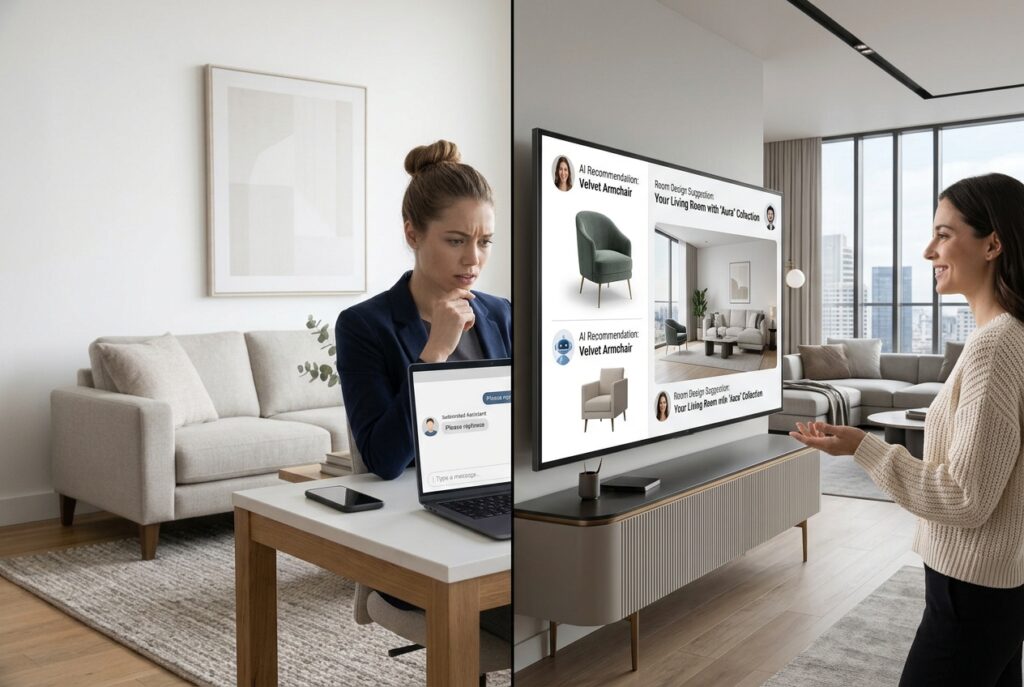
Furniture buyers need help that goes beyond knowing the price or the product specifications; a customer may want to find a sofa that suits a specific space, compare different materials, or choose a table that matches the dining room furniture.
Here the limitation of using a traditional chatbot for furniture stores appears. Among the most prominent shortcomings are:
- Relying on predefined questions and responses: The robot may not understand an unexpected phrasing or a question that requires connecting more than one piece of information, so it provides an unsuitable answer or asks the customer to rephrase their inquiry.
- Difficulty understanding the context of the conversation: When the customer moves from asking about the sofa’s dimensions to asking about the colors that suit their room, the robot may not be able to connect the two questions and make use of the previous details.
- Limited product search: It may rely on search keywords and set categories, without understanding the customer’s natural description of their needs or helping them discover suitable alternatives.
- Not understanding images and spaces: The traditional chatbot cannot necessarily analyze a picture of a room or recognize a piece of furniture in order to find products similar to it.
- Weak personalized recommendations: It may display products according to fixed rules, but it cannot necessarily link its suggestions to the customer’s budget, the room’s dimensions, and their personal taste.
- Limited help with design: It usually does not provide an integrated vision for coordinating furniture or planning rooms and linking the design to the products available in the store.
This shows that using a traditional chatbot for furniture stores may be suitable for simple inquiries, but it alone does not cover all shopping needs in the furniture and decor sector.
How Does the Limitation of a Traditional Chatbot for Furniture Stores Affect Its Performance?

The effects of the limitations of a traditional chatbot for furniture stores do not stop at the difficulty of answering some questions, but may extend to the shopping experience, the efficiency of the work team, and sales opportunities.
When the customer does not get the help they need, it becomes harder for them to move from the search stage to making a purchase decision. These effects appear in several aspects:
- Increased pressure on the customer service team: Work teams have to deal with the inquiries the robot was unable to understand, in addition to requests that need ongoing clarification or personal follow-up.
- Stalled purchase decisions: The customer may hesitate to buy a piece of furniture if they do not get clear answers about the sizes, the materials, or how well it suits their home’s space.
- Loss of cross-selling opportunities: When the robot cannot understand the products the customer has chosen and the room’s needs, the store may miss the opportunity to recommend furniture and suggest complementary pieces or suitable accessories.
- Decline in the quality of the shopping experience: Repeating answers unrelated to the question or asking the customer to repeat information may make them feel that communicating with the store does not provide them with real help.
For this reason, store owners need to evaluate furniture store customer service tools according to their ability to help the customer during the shopping journey, and not only the speed of responding to their inquiries.
Hence the importance of moving to solutions that are more capable of understanding context, providing recommendations, and carrying out tasks.
What Is the Difference Between a Chatbot and an AI Agent in Furniture Stores?
The following table shows you the most prominent differences between a chatbot for furniture stores, or the chatbot, and the AI agent in furniture stores:
| Traditional Chatbot | AI Agent | |
| Understanding Questions | Often relies on keywords and predefined scenarios | Understands natural language and the context of the conversation |
| Following the Dialogue | May have difficulty connecting follow-up questions | Makes use of details from the previous conversation |
| Searching for Products | Displays results according to specific search rules | Understands the customer’s description and suggests suitable products and alternatives |
| Understanding Images | Needs additional tools for this task | Can analyze images and recognize furniture and spaces |
| Recommendations | Provides suggestions according to fixed rules | Personalizes recommendations according to budget, preferences, and needs |
| Carrying Out Tasks | Is often limited to responding and directing | Can help with searching, comparing, and managing purchases |
| Sales Support | Answers basic questions | Helps discover purchase intent and provides recommendations related to it |
How Does the Smart Agent Help Furniture Stores Go Beyond the Limits of a Traditional Chatbot for Furniture Stores?

Instead of settling for answering questions, the smart agent helps the store offer an interactive shopping experience that starts with understanding the customer’s needs and extends to helping them choose products and complete their purchases. This appears through a set of capabilities:
- Understanding the customer’s needs and connecting the details given in the conversation to form a clearer picture of the shopper’s request.
- Making product discovery easier and helping the customer search using a text description or an image, while specifying sizes, colors, materials, and budget.
- Providing suitable recommendations that match the customer’s preferences and the space’s needs, instead of displaying general options.
- Supporting interior design by helping plan rooms, coordinate furniture, and link designs to real products from the store’s catalog.
- Helping the customer during the purchase by reviewing the chosen products, managing the cart, tracking the budget, and checking product availability according to the data connected to the store.
- Supporting the sales team and transferring conversations to employees when human intervention is needed, while passing on the details of the customer’s needs and the products they discussed.
How Do Zory’s Smart Agent Solutions Go Beyond the Capabilities of a Traditional Chatbot for Furniture Stores?
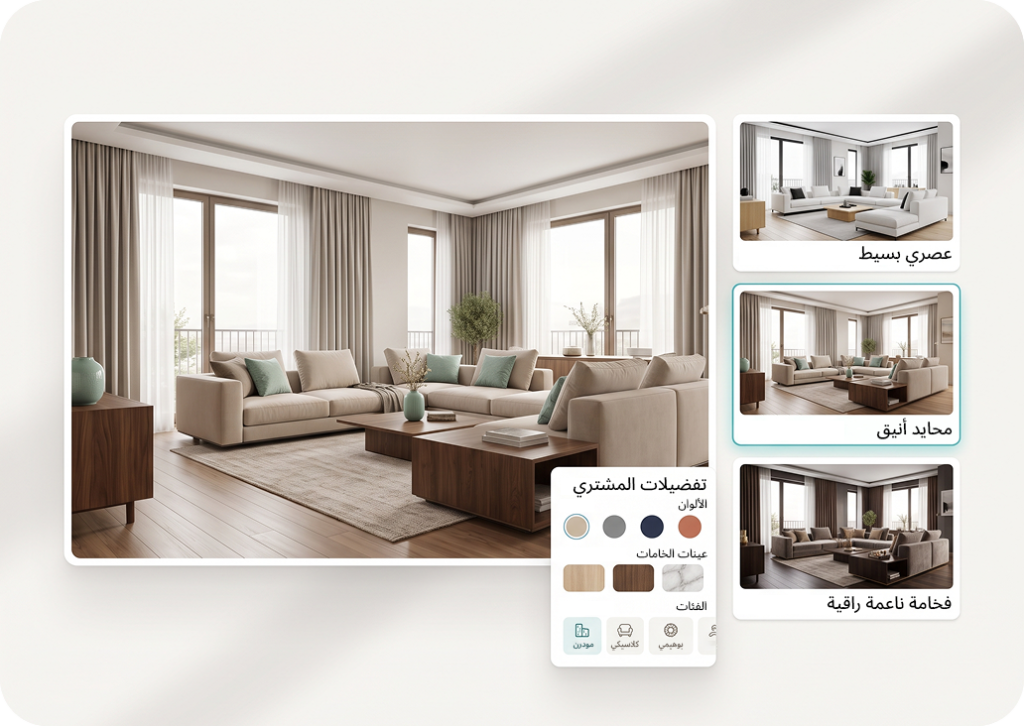
Zory platform offers an applied model of these capabilities by providing more than just a chatbot for furniture stores.
Zory’s smart agent combines conversation, visual search, product and furniture discovery, interior design, and shopping in a single experience directed at the furniture and decor sector.
It also helps furniture retailers understand the products that attract customers’ interest, the frequently asked questions, and the factors that may hinder the purchase decision.
In addition to this, it offers the possibility of customizing the store’s experience and adjusting the agent’s name, personality, and communication tone, and connecting it to the company’s information, the product catalog, and the sales and recommendation rules.
The agent also supports transferring conversations to sales employees when needed, while retaining the context of the interaction to help the employee follow up on the customer’s request.
Conclusion
Customer service in furniture stores is no longer limited to answering frequently asked questions, but now requires understanding the shopper’s needs and helping them choose suitable products and make the purchase decision.
With the variety of these needs, a traditional chatbot for furniture stores is no longer enough to provide an integrated shopping experience.
Contact the sales team now and try Zory’s smart agent, and discover the capabilities of Zory’s smart agent and how it helps provide a more interactive experience for your customers and increase the conversion rate in furniture stores.
FAQs
What Are the Disadvantages of a Traditional Chatbot in Online Stores?
It often relies on predefined responses and scenarios, which limits its ability to understand complex questions, follow the context of the conversation, and provide personalized recommendations to customers.
Can a Chatbot Help Customers Choose Furniture?
Yes, it can display products and answer questions related to their specifications, but its ability to understand the room’s space, coordinate furniture, and suggest personalized options remains limited compared to the smart agent.
What Is the Difference Between a Traditional Chatbot and a Smart Agent?
A traditional chatbot for furniture stores focuses on responding to inquiries, while the smart agent can understand the customer’s needs, analyze the context of the conversation, provide recommendations, and help carry out multiple tasks.
Can a Traditional Chatbot for Furniture Stores Understand Product Images?
Traditional chatbots do not necessarily support this capability; they need specialized technologies to analyze images, recognize furniture pieces, and search for similar products.
Does the Smart Agent Help Increase Furniture Store Sales?
Yes, by making it easier to discover and compare products, providing suitable recommendations, suggesting complementary pieces, and helping customers overcome obstacles that may delay the purchase decision.