



AI furniture recommendation tools have radically changed the way people shop for furniture, but not every tool that promises this actually delivers on it. Choosing the right furniture has always been one of the hardest home decisions. Not because the options are few, but because there are too many of them. You walk into a showroom filled with hundreds of pieces, or open an online store displaying thousands of products, and instead of feeling helped, you feel overwhelmed. Every piece in those outlets looks good on its own, but the question no one answers is: will it look good in my room? This is exactly the problem that AI furniture recommendation tools came to solve.
In this article, we review how AI furniture recommendation tools actually work. We will also show you the best tools you can truly rely on.
Why Do Most People Fail To Choose The Right Furniture?
Choosing furniture seems like a simple decision from a distance, you go or browse, choose, pay, then receive.
But once you actually stand in front of dozens of options in a showroom or scroll through thousands of products in an online store, you discover that simplicity was an illusion.
The problem doesn’t lie in the scarcity of options, but in their abundance without context.
Every piece looks good on its own, but the question that stops every decision is: will it look good in my room specifically? With the furniture I already have, in the space I have, in the colors I love?
And when you don’t find a clear answer to this question, one of two things happens:
- Either you buy and regret it.
- Or you hesitate and postpone indefinitely.
And the cost of a wrong furniture decision isn’t limited to money. A sofa that doesn’t fit the space, a table that doesn’t match the rest of the room in color, a rug that shrinks the space instead of expanding it… all these mistakes live with you daily and remind you of a decision that could have been better.
This is exactly what made AI furniture recommendation tools a real necessity rather than an added bonus.
How Do AI Furniture Recommendation Tools Actually Work?
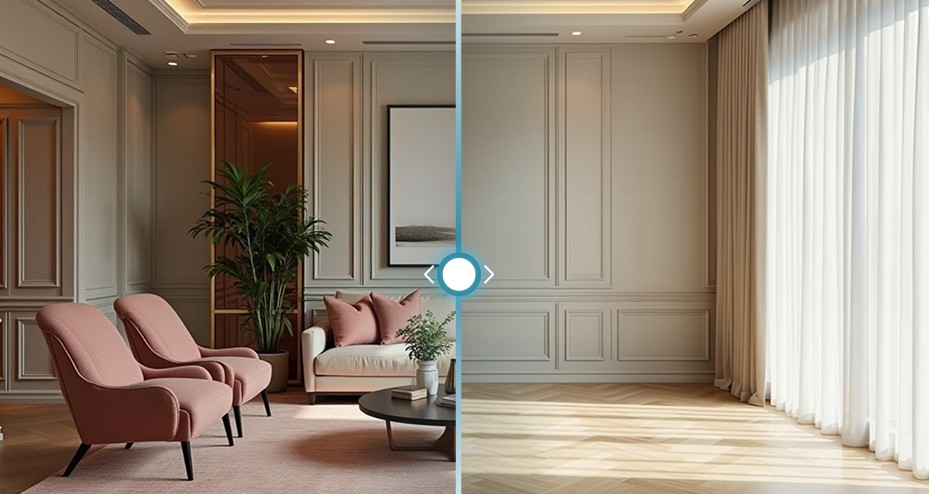
Artificial intelligence in furniture recommendation doesn’t operate on the logic of “what others bought,” but on the logic of “what suits you.” And the difference between the two approaches is huge in terms of result quality.
A genuinely smart tool starts by understanding three fundamental factors before suggesting anything:
- Your taste and style: Do you lean toward luxurious classic, clean modern, or warm natural? A tool that doesn’t understand your style will suggest beautiful pieces that don’t reflect you.
- Your space and its dimensions: A sofa that fits a twenty-five-square-meter living room doesn’t fit a fourteen-square-meter one. AI that takes dimensions into account produces a recommendation that’s actually applicable.
- Harmony with what you already have: A smart recommendation doesn’t suggest a single isolated piece, but suggests a coordinated set that takes into account what you’ve already chosen and what you want to add.
The difference between a genuinely smart recommendation and a disguised random one shows up in the details, where:
- A random recommendation shows you popular products or products with a high profit margin.
- A smart recommendation shows you products that match your taste, space, and budget, and that harmonize with the rest of your choices.
This difference is what makes a difficult decision feel natural and clear, which is also why choosing the right AI furniture recommendation tools is indispensable.
What Actually Makes AI Furniture Recommendation Useful?

Not every recommendation that comes from artificial intelligence is a useful recommendation.
What makes a recommendation lead to a real decision rather than more browsing comes down to three conditions:
Being Tied to your Real Space, Not a General Taste
A recommendation that doesn’t take your room’s dimensions into account shows you what might suit another room, not yours.
That’s why AI furniture recommendation tools that tie their recommendation to your actual space give you an applicable result, not just inspiration.
Harmony of Pieces Together in an Integrated Design
A tool that suggests a separate sofa, a separate table, and a separate rug isn’t offering a recommendation, it’s offering a shopping list.
A tool that brings these pieces together into one coordinated scene shows you the whole room, not separate parts.
Being Tied to Products Actually Available in the Local Market
A recommendation that shows you pieces you can’t find in the market, or that require international shipping with months of waiting, isn’t a useful recommendation, it’s just another frustration in a decision-making journey that was already difficult.
What Do Global Furniture Recommendation Tools Miss In The Gulf Market?

The major global furniture recommendation tools were built primarily for Western markets.
This directly affects how useful they are for a user in the Gulf, in ways many people don’t notice at first but that become clear once actual use begins.
That’s why we find that many global AI furniture recommendation tools offer:
Products you Can’t Find in the Local Market
A tool that suggests furniture from stores that don’t ship to the Gulf, or that require shipping costs that double the price of the piece, doesn’t provide real value.
This also adds an extra research step that was the original problem in the first place.
A Design Taste That Doesn’t reflect the Gulf Style
Luxurious classic style, which holds a central place in the Gulf home, attention to large hospitality spaces, and authentic Arabic touches… none of this is understood by a tool built with Western taste.
The recommendations it produces feel out of place in the Gulf context, even when they are beautiful in themselves.
Absence of the Visual Context that Makes a Recommendation Convincing
A recommendation that comes as a list of products with separate photos doesn’t answer the real question.
Seeing the pieces together in a real room is what turns interest into certainty, and this is what most global AI furniture recommendation tools lack.
Best Smart Furniture Recommendation Tool That Understands Your Taste And Your Market In The Arab Gulf
Zory platform ranks among the best AI interior design platforms. It offers the best AI furniture recommendation tools in the Arab Gulf, as it doesn’t just suggest furniture, it builds a room.
The difference between the two is the difference between a tool that adds to your shopping list and a tool that shows you your home before you buy.
What makes Zory’s tool’s different:
- Recommendations built on your style, your room’s dimensions, and your budget: Zory’s AI understands three factors at once: your taste, your space, and what you can spend. Based on these factors, it builds a recommendation that suits you specifically, not a generic recommendation that suits everyone.
- A live catalog with more than 50,000 real products from trusted merchants in the Gulf market: Every piece you see in a Zory recommendation exists in the market and is available for purchase today from a merchant you know and who delivers to you.
- Automatic harmony between pieces in an integrated design: The Zory platform doesn’t suggest isolated pieces, it places them in a real 3D scene that shows you how they will look together in your room.
- From recommendation to purchase in a single session: Once you reach a recommendation that convinces you, you buy directly from the same interface, without leaving and without starting a new search journey.
How Do You Properly Benefit From AI Furniture Recommendation Tools?

Smart tools don’t produce a good recommendation from incomplete information, the quality of what you put in determines the quality of what you get out. To fully benefit from these tools:
- Define your style first before you start. Don’t begin by searching for a specific piece; instead, define the style you want for the room. This decision directs the AI toward recommendations that truly reflect what you want.
- Upload the room plan and enter your space’s real dimensions, not a rough estimate. The more accurate the dimensions, the far more accurate the recommendation. Real dimensions are the foundation that makes every recommendation applicable.
- Rely on the integrated design, not individual pieces. When evaluating a recommendation, don’t evaluate it piece by piece, evaluate it as a complete scene. A piece that looks ordinary on its own might light up the whole room once you see how it harmonizes with the rest of the design.
- Compare more than one recommendation before the final decision. A smart tool gives you more than one option, take advantage of that. Two or three models showing you the same room in different styles give you far more clarity than looking at a single option alone.
The Zory platform offers you more than just an AI furniture suggestion, it also lets you modify your current furniture, or even easily replace your furniture with new models.
It also provides smart tools that let you design a room in an inspired style and find the closest matching furniture for it, along with other smart tools that let you preview everything before buying, and get the furniture in one step.
For Interior Designers: How Do AI Furniture Recommendation Tools Raise The Value Of Your Services?

An interior designer who uses a smart recommendation tool doesn’t just offer suggestions, they offer a vision.
And the difference between the two shows up in the client’s reaction and in how quickly the deal closes.
Here’s how a smart furniture recommendation tool changes the nature of a designer’s work:
- From a manual suggestion that takes days to an instant recommendation within the session: The smart tool finds coordinated pieces for you, prepares mood boards, and coordinates with suppliers. All of this lets you spend your time on creativity, direction, and the relationship with the client.
- Gives the client multiple options in record time: These tools allow for three or four models in the same session, each with different recommendations. The client chooses rather than merely accepts, and builds emotional ownership of the decision from the very first session.
- The smart recommendation as a persuasion tool, not just a selection tool: When a client sees pieces come together in a real visual scene within their actual room, they don’t need further convincing. The image convinces in ways words cannot reach. This shortens revision rounds and brings the final decision closer.
This is exactly what the Zory platform provides for interior designers. Through it, an interior designer can benefit from advantages that go beyond mere furniture recommendation. The platform helps them:
- Turn room floor plans into 3D visualizations within minutes.
- Suggest real products from a catalog of more than 50,000 products from trusted merchants in the Gulf, taking style, dimensions, and budget into account.
This gives the interior designer a more professional experience, speeds up decision-making, and allows the client to see and interact with the design before execution begins.
Conclusion
Choosing the right furniture was never just a matter of taste, it was always a matter of information.
The right information about your space, about what actually harmonizes, and about what’s available in the market you’re shopping in.
And when this information comes together in a smart tool that translates it into a clear visual recommendation, hesitation stops and the decision begins.
AI furniture recommendation tools have become numerous, but the tool that understands your market, your taste, and your space, and ties its recommendation to products you can actually find, is the tool worth your time and investment.
Zory was built to be this tool in the Gulf market, with recommendations built on your real taste, a catalog of more than 50,000 products from trusted merchants, and an experience that ends in a confident decision, not an open question.
Try Zory today, and discover how the journey of choosing furniture transforms from a maze of options into a clear decision you can see before you buy it.